You invested time and money into building your website. It looks professional, your products or services are listed, and everything seems to work properly. However, weeks or even months later, you realise that hardly anyone is visiting it.
If you’ve found yourself asking, “Why is my website not getting traffic?”, you’re not alone. The truth is that simply having a website does not guarantee visitors. Google has to discover your website, understand what it offers, trust its content, and decide that it deserves to appear ahead of thousands of competing websites. If any part of that process breaks down, your website may struggle to attract organic traffic.
Below are the most common reasons a website is getting no visitors.
The Short Answer
If you’re wondering, “Why is my website not getting traffic from Google?”, the answer usually comes down to one or more of these twelve common issues:
- Your website hasn’t been indexed by Google.
- You’re targeting keywords that nobody searches for.
- You’re competing for keywords that are too competitive.
- Your website is too new
- Your content doesn’t match what users are looking for.
- Your pages load too slowly.
- Your website isn’t mobile-friendly.
- You have very few quality backlinks.
- Your pages don’t fully answer visitors’ questions.
- Your website lacks trust and authority.
- You’re not publishing enough high-quality content.
- You’re ignoring local SEO opportunities.
1. Google Hasn’t Indexed Your Website
Google does not know your website exists.
If your website isn’t in Google’s index, it cannot appear in search results. It doesn’t matter how beautiful your design is or how valuable your services are.
This is especially common for businesses that have recently launched a website. Many owners assume Google automatically finds every new website, but that’s not usually the case.
A quick way to check is to search Google using:
site:yourwebsite.com
If no pages appear, your website may not be indexed.
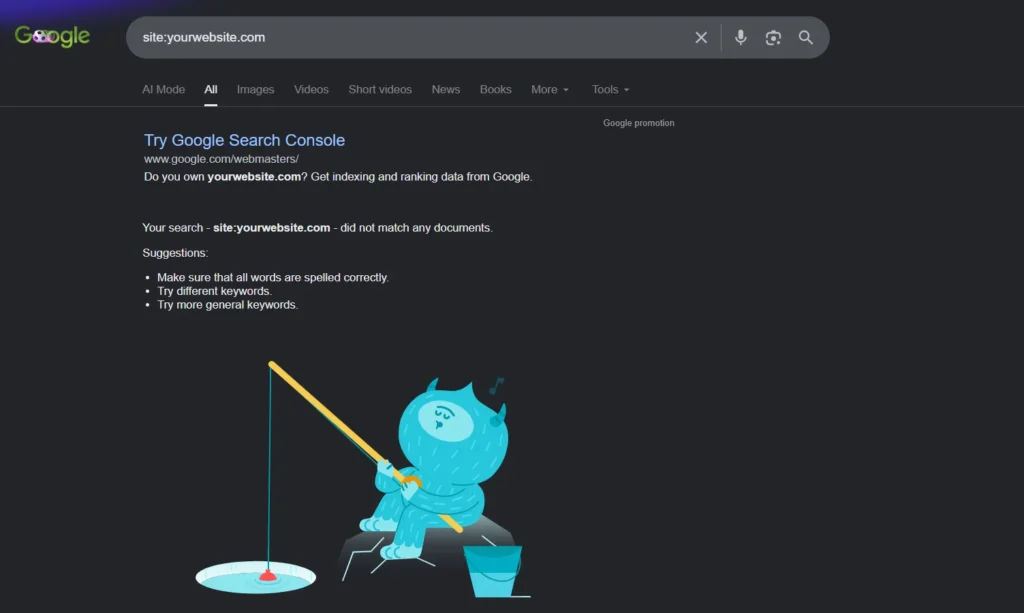
You should also log into Google Search Console and check the Pages report. It will show you whether your pages have been indexed or whether Google encountered errors during the indexing process.
2. You’re Targeting Keywords Nobody Searches For
Sometimes, your website ranks exactly where it should but for keywords that almost nobody uses.
This means you’ve invested time writing content that doesn’t generate visitors because there is little or no search demand.
For example, imagine a Lagos-based accounting firm writes an article titled:
“Innovative Financial Excellence Solutions for Growing Enterprises”
While it sounds professional, very few people will ever search for that phrase.
Instead, potential customers are searching for things like:
- Tax consultant in Lagos
- Accountant near me
- Bookkeeping services in Nigeria
- Business tax filing help
Google can only send visitors if people actually search for your target keywords.
3. You’re Targeting Keywords That Are Too Competitive
This is the opposite problem to the previous reason.
Some businesses target incredibly competitive keywords.
Imagine launching a brand-new website and expecting to rank for:
- Korean skincare
- Business news
- Digital marketing
These keywords are dominated by global brands that have spent years building authority.
Trying to outrank them immediately is unrealistic.
Google rewards websites that have demonstrated expertise over time.
Large companies usually have thousands of backlinks, hundreds of articles, strong brand recognition, high domain authority, and years of publishing history.
If your website is relatively new, competing head-to-head with them becomes extremely difficult.
Read also: What to Ask Before Hiring an SEO Expert
4. Your Website Is Still New
One of the hardest truths for business owners to accept is that SEO takes time.
If your website launched only a few weeks or months ago, Google is still learning about it.
Google needs time to:
- Crawl your pages
- Evaluate your content
- Understand your niche
- Compare you with competitors
- Assess user engagement
- Measure trust signals
This process cannot be rushed overnight.
Ask yourself:
- Did you launch your website within the last six months?
- Have you only published a handful of pages?
- Do you have very few backlinks?
- Is your website still growing?
If you answered yes, patience is part of the solution.
5. Your Content Doesn’t Match Search Intent
Even if you target the right keywords, Google won’t rank your page if it doesn’t satisfy search intent.
Search intent refers to the reason behind someone’s search.
For example, someone searching:
“How to bake bread” wants instructions.
“Bread bakery near me” wants a local business.
“Best SEO services in Lagos“ is looking to hire an SEO company.
Each search requires a completely different type of page.
Suppose someone searches “bread bakery near me”; they expect to see a Google map listing of different bakeries.
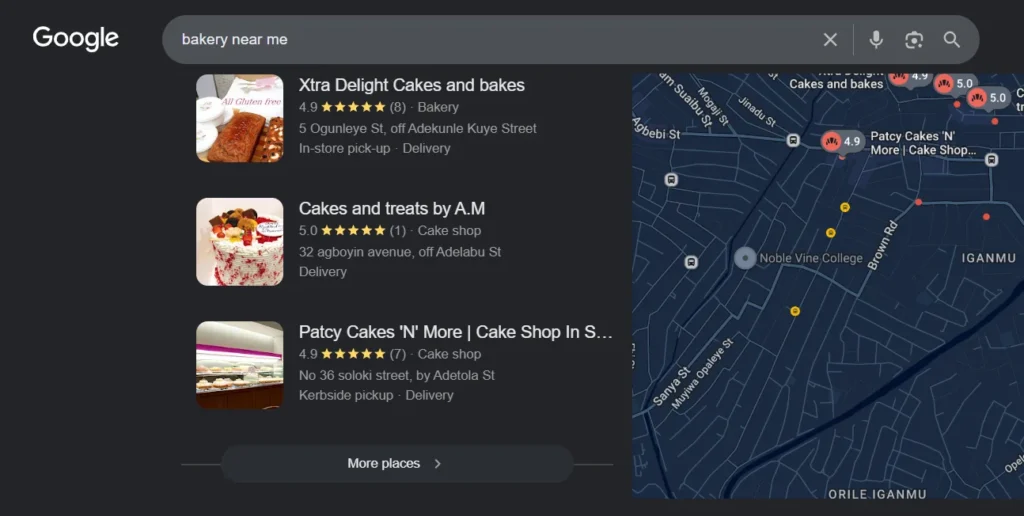
If Google instead finds a page discussing the history of bread making, it won’t satisfy the searcher’s intent.
As a result, that page is unlikely to rank well.
6. Your Pages Don’t Fully Answer Users’ Questions
Google’s goal is to give searchers the best possible answer.
If your page only scratches the surface while your competitors provide detailed, practical, and well-structured information, Google will usually rank their pages higher.
This is one of the biggest reasons a website not getting traffic continues to struggle despite publishing regular content.
For example, imagine someone searches:
“How to bake bread”
If your article simply says:
Buy flour
Mix the dough
Place in oven
…it doesn’t offer much value.
However, another article explains each step, provides examples, includes screenshots or videos, answers related questions, and offers actionable advice. Google is far more likely to recommend that page.
7. Your Website Is Too Slow
Nobody enjoys waiting for a slow website to load.
Neither do search engines.
Website speed affects both user experience and SEO, making it an important ranking factor.
If your pages take several seconds to load, many visitors will leave before they even see your content.
Google notices this behaviour and may reduce your rankings over time.
A slow website can lead to higher bounce rates, lower engagement, fewer enquiries, and ultimately reduced conversions.
This is particularly important in Nigeria, where many users browse the internet using mobile data. A heavy website with oversized images or unnecessary scripts can become frustrating to use.
Google measures website performance using Core Web Vitals.
These metrics evaluate loading speed, visual stability, and responsiveness.
Poor scores can make it harder to compete against faster websites.
8. Your Website Isn’t Mobile-Friendly
More people in Nigeria browse the internet on smartphones than on desktop computers.
That’s why Google primarily evaluates the mobile version of your website when determining rankings.
If your mobile experience is poor, your visibility may suffer.
Common mobile responsiveness issues include:
- Tiny text that’s difficult to read.
- Buttons placed too close together.
- Horizontal scrolling.
- Images that don’t resize properly.
- Slow loading on mobile devices.
- Menus that are difficult to navigate.
Visitors who struggle to use your website will usually leave quickly.
Google wants to recommend websites that provide an excellent experience across all devices.

If your competitors offer a smoother mobile experience, they’ll often outrank you.
9. You Have Very Few Quality Backlinks
Think of backlinks as recommendations.
When another reputable website links to yours, Google sees it as a signal that your content is trustworthy and valuable.
Not all backlinks are equal, however.
A single link from a respected industry website can be worth far more than dozens of links from low-quality directories.
Google uses backlinks to measure authority.
If your competitors have earned links from news websites, industry blogs, business directories, and professional associations, while your website has almost none, Google may consider them more authoritative.
10. You’re Ignoring Local SEO
If you serve customers in Nigeria, local SEO should be a major part of your marketing strategy.
Unfortunately, many businesses optimise only for broad keywords while ignoring searches with local intent.
Imagine you own a dental clinic in Ikeja.
Would you rather rank for:
“Dentist”
or
“Dentist in Ikeja”?
The second keyword attracts people who are much closer to becoming customers.
Google increasingly personalises search results based on location.
Someone searching from Lagos is more likely to see businesses located nearby than companies based in another state or country.
This makes local SEO particularly valuable for hospitals, restaurants, hotels, schools, salons and other businesses whose customers walk in.
Many Nigerian businesses:
- Don’t create a Google Business Profile.
- Fail to include location-specific keywords.
- Have inconsistent business information across directories.
- Don’t collect customer reviews.
- Ignore location pages.
As a result, they miss opportunities to appear in Google’s Local Pack.
11. Google Doesn’t Trust Your Website Yet
Google wants to recommend websites that are accurate, reliable, and trustworthy.
That’s where E-E-A-T comes in.
E-E-A-T stands for:
- Experience
- Expertise
- Authoritativeness
- Trustworthiness
Although it isn’t a direct ranking factor, Google uses these concepts to evaluate the overall quality of your website.
Imagine two websites offering financial advice.
One is written by an experienced accountant, includes detailed author profiles, cites reputable sources, and displays genuine customer testimonials.
The other contains anonymous articles with little supporting information.
Which one would you trust?
Google asks the same question.
Strong websites often include:
- Detailed About pages.
- Professional author biographies.
- Contact information.
- Customer testimonials.
- Consistent branding.
These signals reassure both visitors and search engines.
12. You’re Publishing Too Little Content
Many businesses launch a website with:
- Home page
- About page
- Services page
- Contact page
…and then stop publishing.
Months later, they wonder, “Why is my business website not getting traffic?”
The answer is simple.
Google rewards websites that consistently demonstrate expertise.
One of the best ways to do this is through valuable content marketing.
Every helpful article gives your website another opportunity to rank.
For example, a beauty store could publish articles about:
Which sunscreen is the best for Lagosians?
How long does it take for acne to disappear?
How much is a manicure in Lekki?
Each article targets different search queries while building authority around beauty.
Together, they create topical authority, making it easier for your entire website to rank.
FAQs About Lack of Website Traffic
Why does my website get impressions but no clicks?
If your website receives impressions but very few clicks, your pages may not be attracting attention in the search results. Improving your page titles, meta descriptions, and matching search intent more closely can increase your click-through rate.
Why isn’t Google indexing my website?
Google may struggle to index your website if your pages contain duplicate or thin content, your robots.txt file blocks crawling, or your XML sitemap hasn’t been submitted. Reviewing your indexing report in Google Search Console is the best place to start.
Can a website exist without traffic?
Yes. Thousands of websites receive little or no traffic because they haven’t been optimised for search engines. Without proper SEO, even well-designed websites can remain virtually invisible online.
Conclusion
Rather than making random changes and hoping for better results, take a systematic approach. Start by checking whether Google has indexed your pages, review your keyword targeting, improve your content, fix technical problems, and monitor your performance using Google Search Console and Google Analytics.
If you’ve worked through the steps in this guide and your website is still not getting traffic, it’s time to take a closer look. At SEO Services in Lagos, we provide comprehensive SEO audits that uncover exactly what’s holding your website back.
Ready to find out why your website isn’t attracting visitors? Contact us today for a professional SEO audit and discover the practical steps that can help your business generate more traffic, more enquiries, and more sales.